
Google Ads Smart Bidding Doesn't Work for Most Professional Services Firms. Here's What Does.
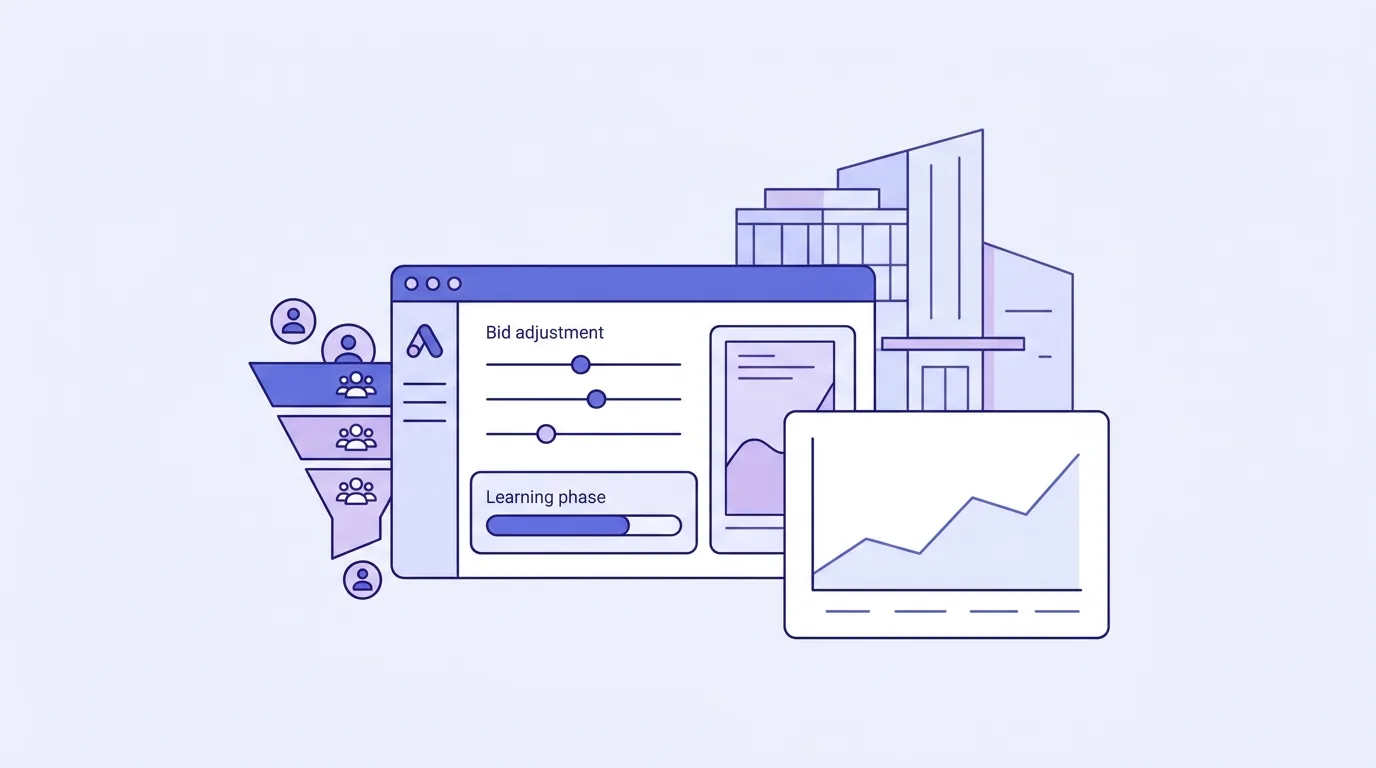
Smart Bidding requires at least 50 conversions per month to exit the learning phase and optimise reliably. The average law firm, accounting practice, or financial advisory firm generates somewhere between 8 and 20 enquiries a month from Google Ads. That gap is why so many professional services campaigns quietly underperform for years: the algorithm is permanently learning on stale, insufficient data, and nobody in the account realises it.
This is not a knock on Smart Bidding. It is brilliant for high-volume advertisers. The problem is that the professional services sector has the exact combination of conditions that make it work poorly: high CPCs, cautious buyers with long research cycles, and lead volumes that are structurally limited by the size of the firm and the nature of the work. Running Target CPA on eight leads a month is the paid search equivalent of trying to train a machine learning model on a dozen data points.
Here is what to use instead, and how to work your way toward smarter bidding once you have built the foundation.
Why Smart Bidding Fails in Low-Volume Professional Services Accounts
Google’s Smart Bidding documentation recommends a minimum of 50 conversions in the last 30 days for Target CPA campaigns to work as intended. Campaigns that fall below this threshold are flagged as “learning limited” and the algorithm falls back on historical averages rather than real optimisation. In practice, this means you are paying automated-bidding prices for what is effectively manual bidding performance.
The “learning limited” warning is easy to miss. It appears in your campaign status column, and many advertisers either ignore it or do not know what it means. If your account has been running Target CPA on fewer than 30 conversions a month, it is almost certainly learning limited most of the time.
There is also the problem of what happens every time you change something. Smart Bidding resets its learning phase whenever you adjust your Target CPA by more than a modest amount, increase or decrease your budget significantly, add or remove ad groups, or make substantial keyword changes. For a small professional services account that generates 10 leads a month, a single learning reset takes three to four weeks to recover from. If you are making regular account changes, the algorithm is in permanent learning mode.
The result is a campaign that looks like it is running Smart Bidding but is functionally guessing, and it is guessing with your budget.
The Three Bid Strategies That Work for Low-Volume Accounts
Maximise Conversions Without a CPA Target
This is the most underused starting point for professional services firms, and it is the right place to begin.
Maximise Conversions without a Target CPA does exactly what the name says: it spends your full daily budget trying to get as many conversions as possible within that budget. Crucially, it does not require the 50-conversion minimum. It starts learning from the first lead, and because it has a budget constraint rather than a CPA target, it does not get stuck in the same way as Target CPA when volumes are low.
The catch is that you have no control over what it pays per conversion. It will spend your full budget, so if your budget is $150 per day and the algorithm only finds one strong opportunity, it might spend most of that chasing a single lead. For professional services where a single client is worth $5,000 to $50,000, that is usually acceptable arithmetic, but you need to watch actual CPLs weekly and be prepared to adjust the budget if the numbers move outside a range you can sustain.
Run Maximise Conversions without a target for at least three months, or until you have accumulated 50 or more conversions. At that point, you have real data to set a Target CPA that reflects actual market conditions rather than guesswork.
Manual CPC With Enhanced CPC
Manual CPC is not the backwards choice it sounds like. For low-volume professional services accounts, it is often the most controlled and predictable strategy, and it forces you to think carefully about which keywords actually deserve a premium bid.
Enhanced CPC (eCPC) sits on top of Manual CPC and adjusts your bids upward or downward in real time based on signals Google has about the search, device, location, and audience. You set the base bid, and eCPC nudges it. The key difference from Target CPA is that eCPC never completely overrides your manual input. You remain in control of the floor.
For a Wellington accounting firm bidding on “GST return accountant Wellington”, Manual CPC lets you set a deliberate bid for that specific, high-intent term. You might bid $18 for that keyword and $8 for broader informational terms. Smart Bidding does not give you that level of control. In a low-volume account where every conversion carries significant weight, the ability to manually weight your most valuable keywords is genuinely useful.
The downside is time. Manual CPC with eCPC requires active bid management. You should be reviewing your keyword bids at least every two weeks, adjusting based on what is converting and what is not. For a small account, that is a manageable commitment. For a larger account with hundreds of keywords, it becomes impractical quickly.
Portfolio Bid Strategies
If your firm runs multiple campaigns, portfolio bid strategies are worth understanding. A portfolio strategy pools conversion data across all the campaigns you add to it and optimises toward a shared Target CPA or Target ROAS.
In practice, this means a firm running separate campaigns for “family law”, “commercial litigation”, and “employment law” can combine their conversion data. Instead of each campaign trying to learn from its own four conversions a month, the portfolio has 12 to work from. You still need to reach the 50-conversion minimum across the portfolio to get reliable optimisation, but it is easier to hit that threshold when you are pooling multiple campaigns.
Set up portfolio bid strategies through the Shared Library in Google Ads. The key consideration is that campaigns in the same portfolio need to have meaningfully similar CPL targets. Putting a campaign for high-value corporate litigation alongside a campaign for low-cost conveyancing creates a portfolio where the algorithm cannot optimise cleanly toward either goal.
How to Feed Your Campaigns Better Signals
The single biggest lever for improving Smart Bidding performance in professional services is not the bid strategy you choose. It is the quality and completeness of the conversion data you feed the algorithm.
Most professional services firms track only one conversion: the form submission. That is a binary signal with limited resolution. Every form submission looks the same to the algorithm whether it came from an ideal client or someone who will never convert to real work.
Set Up Micro-Conversion Tracking
Micro-conversions are lower-intent actions that tell Google something about how visitors engage with your site before they enquire. Common ones for professional services include:
- Click-to-call events (someone tapping your phone number on mobile)
- Time-on-site milestones (visiting your site for more than two minutes)
- Key page visits (pricing, team, specific service pages)
- Form starts (someone opening the form even if they do not submit)
Set up these micro-conversions in Google Analytics 4 and import them into Google Ads, but set them as “observation” rather than “conversion” goals, or use them as secondary conversions only. The primary conversion should remain the form submission. Micro-conversions inform the algorithm without diluting the signal from your real goal.
The reason this helps: Google’s algorithm is looking for patterns in who converts. If the only pattern it can observe is “this person submitted a form”, it has little to work with. When it can also observe “people who visited the team page and then the pricing page are three times more likely to submit a form”, it can start bidding more aggressively for users who match those behaviour patterns.
Import Offline Conversion Data
This is the highest-value data feed for professional services accounts, and almost no small firms use it.
When a lead becomes a client, that is information Google never sees unless you tell it. A firm that closes 30% of its enquiries into paying clients, and gives Google that signal, is running a fundamentally smarter campaign than an identical firm that only reports form submissions. The algorithm learns that certain keywords, ad types, and audience signals produce not just enquiries but actual clients, and it shifts budget toward those sources.
The mechanics require some setup. You need to either use Google Ads offline conversion imports via a CRM integration, or manually upload a CSV of converted leads with the Google Click ID (GCLID) that was captured at the time of the original click. Most CRMs, including HubSpot and Salesforce, support GCLID capture and offline conversion export.
For a firm where the gap between an enquiry and a signed client matter is weeks or months, the attribution window matters. Google allows offline conversion windows up to 90 days, which covers most professional services sales cycles.
When to Move to Target CPA
Once your account has accumulated 50 or more conversions across the trailing 30 days, you are ready to test Target CPA. Do not set a target below what you are currently paying per conversion. If your average CPL on Maximise Conversions has been $95, set your initial Target CPA at $110 to $120. Giving the algorithm a tight target immediately tends to trigger aggressive bid reductions that cut traffic volume before the system has time to find efficient sources.
Hold the initial Target CPA for at least four to six weeks before making adjustments. If the CPL is comfortably below your target and conversion volume is stable, you can tighten the target by 10 to 15 percent. If volume drops off sharply, loosen it. The goal is to gradually compress the target toward the CPL you want, not to set it and forget it.
One thing to watch: professional services conversion rates fluctuate by month for reasons that have nothing to do with your ads. A law firm gets fewer new enquiries in January and December. An accounting practice spikes around March and October. If you set a Target CPA during a high-conversion month and the algorithm bakes that volume expectation in, you will see campaign performance degradation in quieter months even though your actual efficiency is unchanged. Factor seasonal patterns into your target review.
The Mistakes That Keep Campaigns in Learning Mode
Even firms that graduate to Target CPA often stay in learning mode because of how they manage the account. A few specific patterns to avoid.
Frequent bid target adjustments. Every time you change your Target CPA by more than a modest amount, the algorithm treats it as a meaningful change and re-enters a learning window. If you are checking performance weekly and adjusting targets based on short-term fluctuations, you are resetting the learning phase faster than it can recover. Make target adjustments no more than once a month, and only when you have enough data to justify the change.
Budget changes that exceed 20 percent. Increasing or decreasing your daily budget by more than around 20 percent triggers a reset. If you need to scale budget up, do it incrementally over multiple weeks rather than doubling your budget in a single change.
Structural changes during active optimisation. Adding new ad groups, pausing high-converting keywords, or launching new campaigns in the middle of a Smart Bidding optimisation window forces the algorithm to relearn. Batch structural changes together and make them at the start of a period when you are expecting lower volume.
Tracking gaps. If your conversion tracking goes dark for any period, even briefly, the data gap sends the algorithm into a re-learning cycle. Check your conversion tracking status regularly. A broken tracking tag is one of the most common causes of unexplained campaign degradation in professional services accounts.
Building Toward Better Bidding Over Time
The arc for most professional services accounts looks like this: start on Maximise Conversions without a CPA target, add micro-conversion tracking within the first month, build the offline conversion import process within the first quarter, and review Target CPA readiness once you have 50 trailing conversions in a month. That timeline is typically six to twelve months for a firm generating 10 to 15 leads a month, which is the realistic volume for most practices.
The firms that try to skip this process and start on Target CPA with eight conversions a month spend more, convert less, and conclude that Google Ads does not work for professional services. The firms that do the groundwork spend the same or less and get leads that close at a materially higher rate because the algorithm is learning from the right signals.
The structural economics of professional services Google Ads are genuinely challenging, as the cost per lead benchmarks for professional services make clear. But bid strategy accounts for a meaningful part of why some firms get acceptable CPLs and others do not. It is one of the controllable variables, which makes it worth getting right.
FAQs
What is the minimum conversion volume needed for Smart Bidding to work properly?
Google recommends a minimum of 50 conversions in the trailing 30-day window for Target CPA campaigns. Below that threshold, campaigns are typically flagged as “learning limited” and the algorithm defaults to averages rather than genuine optimisation. For low-volume professional services accounts, Maximise Conversions without a target or Manual CPC with Enhanced CPC are more reliable starting strategies.
Should a small law firm use Target CPA or Manual CPC?
If your account generates fewer than 30 to 40 conversions per month, Manual CPC with Enhanced CPC or Maximise Conversions without a target will generally outperform Target CPA. Start with whichever approach gives you the most control over your budget, build conversion volume over three to six months, then test Target CPA once you have enough data for the algorithm to learn from.
How does offline conversion import help Google Ads for professional services?
Offline conversion import lets you tell Google which enquiries actually became clients, rather than treating all form submissions as equal. When the algorithm knows that certain keywords produce clients at twice the rate of others, it can shift budget toward the higher-value source. It requires setting up GCLID capture in your intake process and either a CRM integration or a regular manual upload.
Why does my Google Ads campaign keep entering learning mode?
The most common causes are frequent Target CPA adjustments, budget changes exceeding 20 percent, structural changes like adding or removing ad groups, and broken conversion tracking. Smart Bidding treats each of these as a meaningful change that requires recalibration. Limit major account changes to once a month and check your conversion tracking tag health regularly.
What is a portfolio bid strategy in Google Ads?
A portfolio bid strategy pools conversion data across multiple campaigns and applies a shared Target CPA or Target ROAS to all of them. For a professional services firm running separate campaigns for different service areas, this allows the algorithm to learn from the combined conversion volume rather than each campaign’s individual data. It is particularly useful when individual campaigns generate fewer conversions than the Smart Bidding minimum.
Get Your Google Ads Account Set Up to Learn Properly
The firms that get reliable results from Google Ads are not always the ones spending the most. They are the ones whose accounts are structured in a way that gives the algorithm something to work with. That means the right bid strategy for your current conversion volume, clean tracking, and a plan to build toward Target CPA once the data is there.
If your professional services Google Ads account has been running for months without a clear view of what your actual cost per client is, book a strategy call with Lucid Leads. We work specifically with New Zealand professional services firms and we can usually identify the core issue in a single account review.
Related Articles
Continue learning about lead generation and paid advertising
Why Professional Services Firms Pay More for Google Ads Leads (And How to Close the Gap)
Attorneys average $131.63 CPL and finance firms 2.64% conversion rate in 2026. Here's why professional services pay more and how to fix it.

Lead Generation for Consultants in NZ: How to Build a Client Pipeline Beyond Referrals
Most NZ consultants rely entirely on referrals. Here's how management, IT, and HR consultants can build a predictable lead pipeline using paid ads and content.
Written by

Founder & Lead Generation Specialist
Jason Poonia is the founder of Lucid Leads, helping service businesses across New Zealand generate qualified leads through paid advertising and conversion-focused funnels. With a background in Computer Science from the University of Auckland and over 5 years of experience running lead generation campaigns, Jason has helped businesses in construction, trades, real estate, and professional services generate thousands of qualified leads. His data-driven approach combines targeted ad strategies with rapid lead qualification to deliver prospects who are ready to buy.