
Why Professional Services Firms Pay More for Google Ads Leads (And How to Close the Gap)
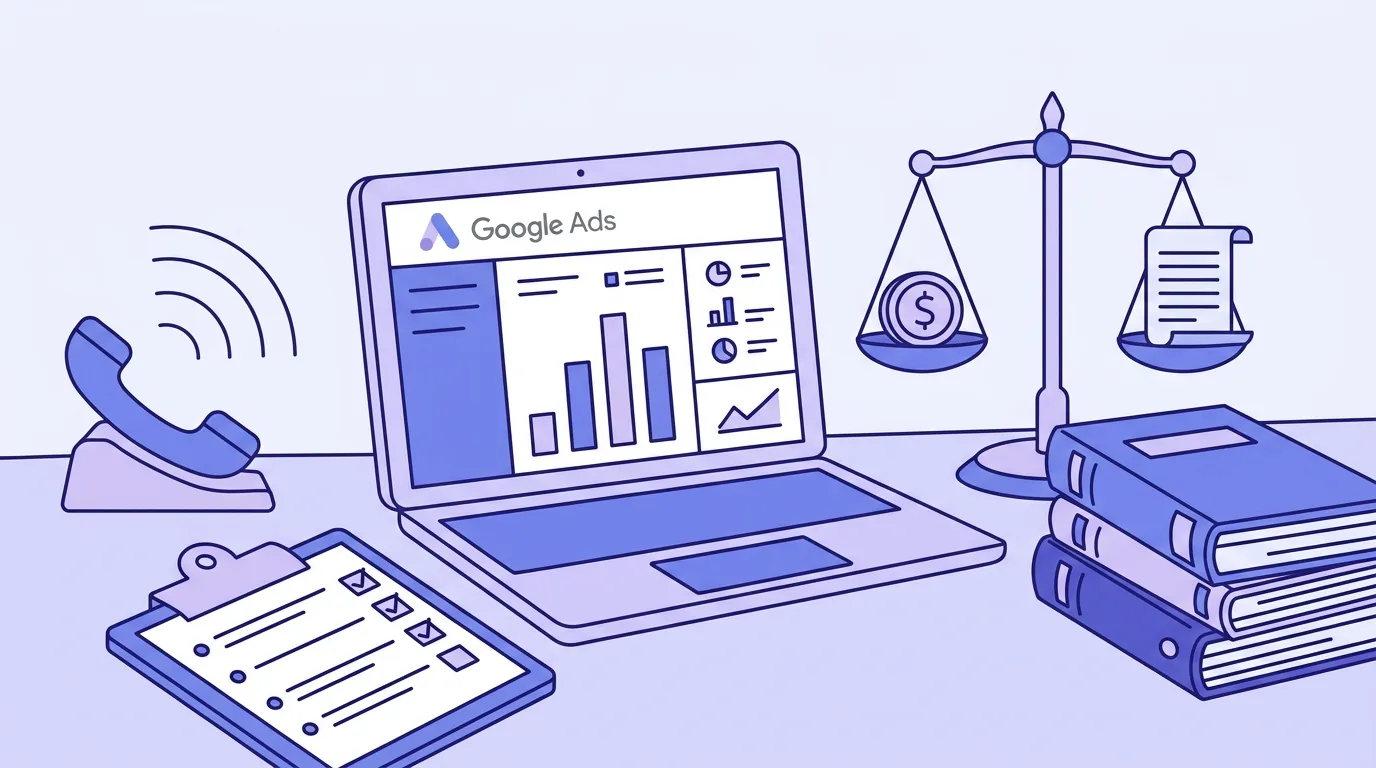
Law firms, accountants, financial advisers, and consultants pay more for Google Ads leads than almost every other category of business. According to a WordStream by LocaliQ study covering April 2025 to March 2026, attorneys and legal services average a $131.63 cost per lead, the highest of any industry measured. Finance and insurance firms convert at just 2.64%, the lowest conversion rate of any sector. Business services, which includes accounting and consulting, sits at a $93.69 CPL with conversion rates declining 5.65% year over year.
Those numbers are real. But they are not a verdict on whether Google Ads works for professional services. They are a starting point for understanding why the channel behaves differently here, and what you need to change to make the maths work.
What the 2026 Benchmark Data Shows
The industry average across all Google Ads sectors in 2026 is a $66.69 CPL at an 8.18% conversion rate. Professional services categories sit well above that cost baseline and well below that conversion rate.
The legal category is the starkest case. At $9.87 average cost per click and $131.63 per lead, you are paying roughly double the channel average for every enquiry. Finance and insurance have a lower CPC, but with a 2.64% conversion rate you need roughly three times more traffic than the average advertiser to generate the same volume of leads.
These are structural numbers. They reflect genuine market dynamics: highly competitive search auctions, cautious buyers who research carefully before contacting anyone, and industries where one wrong choice carries serious consequences. You cannot change the industry dynamics.
What you can change is how much of that structural cost you compound through your own setup. Most professional services firms are paying the full structural premium and then adding to it with fixable mistakes. The gap between the worst-performing accounts and the best within a given industry is far wider than the gap between industries.
Why Professional Services Buyers Behave Differently
Before getting to the fixes, it helps to understand why conversion rates are lower here than in most categories.
A person searching for a plumber is ready to call. They have a burst pipe. Their decision window is minutes.
A person searching for a financial adviser, a commercial lawyer, or an accountant is at the start of a research process that can take weeks. They are comparing credentials, reading reviews, checking regulatory registrations, and forming a trust judgement before they will hand over personal or financial information. They will visit your site, leave, come back, compare two or three others, and then enquire only if you have cleared their trust threshold.
This longer research cycle means a first visit rarely converts. It also means your landing page is not just a conversion tool. It is an audition. The prospect is asking one question your page has to answer: should I trust these people with something important?
Most professional services websites answer that question badly. Generic copy, stock photography, vague credential claims, and a contact form that could belong to any business in any category. If your page looks like everyone else’s, the cautious buyer has no reason to choose you over the other three tabs they have open.
Fix 1: Send Traffic to a Dedicated Landing Page, Not Your Homepage
This is the single most common and most expensive mistake in professional services Google Ads.
Your homepage exists to introduce your whole firm. It has a navigation menu, links to your team page, your services overview, your blog, your about section. A visitor who lands there has six or eight directions they can go, and most of them do not end in an enquiry.
A dedicated landing page for each service has one purpose and one exit: the enquiry form or the phone number. No navigation menu. No links to other pages. One message, one audience, one action.
A firm running Google Ads for business succession planning needs a landing page about business succession planning, with copy that speaks to the person searching that term, with social proof from that specific service, and a form that asks relevant intake questions. Not a homepage with a “services” dropdown.
The conversion rate difference between a well-built dedicated landing page and a homepage is large enough to move your CPL materially. If your current CPL is $131 and your homepage converts at 3%, a landing page that converts at 6% halves your effective cost per lead without touching your bids or budget. For more on the structural difference, see our guide on landing pages versus websites for NZ service businesses.
Fix 2: Lead With Trust Signals That Actually Mean Something
Professional services buyers are not reading your page for features. They are reading it for proof that you are safe to trust with something high-stakes.
Generic trust signals do not move them. “Experienced team.” “Client-focused approach.” “Over 20 years in business.” These phrases appear on every competitor’s site and carry no weight because they are unverifiable and interchangeable.
Trust signals that move the needle for professional services look quite different.
Credentials with specificity. Not “qualified advisers” but “Chartered Financial Analyst, authorised by the Financial Markets Authority.” Not “experienced solicitors” but “members of the New Zealand Law Society, specialising in commercial property for 11 years.” Regulatory registrations and professional body memberships are verifiable. Buyers check them, and seeing them confirmed on your page removes a layer of anxiety.
Outcome descriptions within legal constraints. You cannot promise results, but you can describe the type of work you have done and the general outcomes clients have achieved. “We have acted for more than 60 Auckland businesses on shareholder disputes” is more persuasive than “we have a strong track record.” Specificity is credibility.
Review volume and recency. A Google review profile with 47 reviews averaging 4.8 stars outperforms three testimonials you obviously selected yourself. Link to your live Google review profile or embed a live widget. Curated quotes on a page read as curated. Third-party reviews read as real.
A real face and name. Professional services is a people business. A photo and a brief bio of the person the prospect will actually talk to reduces anxiety. Anonymous “our team” pages do less work than a named professional with a clear specialty and a recognisable face.
Fix 3: Pre-Qualify in the Form
A three-field contact form collects enquiries from everyone: serious prospects, students doing research, competitors, and people who think your immigration lawyer also handles parking fines.
Every one of those submissions costs you the same click price. You only find out which were worth pursuing after you spend time on follow-up.
Adding two or three qualifying questions to your form filters the audience before they submit. It reduces the volume of unqualified enquiries you pay to chase, and it signals to genuine prospects that you are a firm that cares about fit, which is itself a trust signal.
Good qualifying questions by professional services category:
Law firm: Type of matter (dropdown with your practice areas), approximate urgency, have you taken any legal steps on this matter already?
Financial adviser: Approximate investment amount (range options), primary goal (retirement, property, estate planning), do you currently have a financial adviser?
Accounting firm: Business structure (sole trader, company, trust), approximate annual turnover, what triggered your search today?
Consultant: Business size by headcount, primary challenge (dropdown with your service areas), decision timeframe.
Keep the form to five fields maximum. Beyond that, completion rates fall faster than the quality gains justify. For more on the qualification process once leads arrive, see our guide on how to qualify leads in under five minutes.
Fix 4: Make Phone Calls a First-Class Conversion
For most professional services categories, phone calls convert to appointments at a higher rate than form submissions. A person who calls has already decided to engage. They want to confirm it feels right. A person who fills in a form is still on the fence.
This has two practical implications for your Google Ads setup.
First, phone calls must be tracked as conversions. If you are only counting form fills, Google’s bidding algorithm is optimising for a weaker signal. It does not know that the call from last Tuesday turned into a $12,000 retained client. The full technical setup is covered in our guide on phone call lead tracking in Google Ads.
Second, call extensions should be active on every ad, and call-only ads are worth testing for mobile traffic. A tap-to-call button removes all friction from a mobile search. One operational note: if your office closes at 5pm and you are running ads in the evening without an after-hours answering service, you are paying for clicks that go to voicemail and never convert. Either pause ads outside business hours or arrange for calls to be answered.
Fix 5: Teach Google What a Good Lead Looks Like
Google Ads’ bidding algorithms optimise toward whatever conversion actions you tell them to value. If your only tracked conversion is a form submission, Smart Bidding will find people who submit forms. It does not know that one in five submissions is a student or a competitor and the other four are genuine prospects. It treats all five identically.
The most powerful improvement available to high-CPL professional services firms is importing CRM data as offline conversions. Once you connect your CRM to Google Ads, you can feed back which form submissions became consultations, which consultations became clients, and in some setups approximate revenue values. Google’s algorithm then learns to find people who behave like your best clients, not just anyone who clicks and fills in a field.
This is not a quick setup, but it has an outsized effect in categories where lead quality varies widely. If a full CRM integration is not feasible right now, the minimum version is to assign differentiated conversion values: a phone call is worth more than a form fill, a consultation booking is worth more than a call. That gives Smart Bidding a quality gradient to work with even without offline data.
For more on structuring lead quality assessment, see our guide on lead scoring for NZ service businesses.
Does the Maths Still Work? A Sense-Check
The question professional services firms should ask about their Google Ads CPL is not “is this cheap?” but “does this make sense against our client economics?”
Consider the arithmetic for a hypothetical accounting firm. If the CPL is around $93 and 40% of enquiries book a discovery call and 35% of those calls result in an engagement, the effective cost to acquire a new client works out to roughly $665 (that is $93 divided by 0.14). If that client pays $3,500 per year in fees and stays for four years on average, the lifetime value is $14,000. A $665 acquisition cost is less than 5% of LTV. That arithmetic works.
For a law firm at $131.63 CPL: if 50% of enquiries book a consultation and 30% of consultations proceed to a retainer, the effective client acquisition cost is around $877. Against a $6,000 average matter value that is a 15% acquisition ratio. Still viable, as long as the intake process qualifies enquiries quickly.
The reason many professional services firms conclude that Google Ads does not work is that they see the CPL, decide it is too high, and pull the budget, rather than working back from client LTV and fixing the intake process driving the conversion gap. The channel can work for any professional services firm with a client lifetime value above $3,000. The problem is almost never the channel. It is the landing page, the trust signals, the form questions, and the follow-up speed.
Frequently Asked Questions
Why is the cost per lead so high for legal and financial services?
Competitive search auctions and cautious buyers are the two structural reasons. Legal and financial searches attract many well-funded advertisers bidding on the same terms, which pushes CPCs up. Buyers in these categories research for longer and convert more slowly, which pushes conversion rates down. Both factors are inherent to the category. The gap between a well-configured campaign and a poorly configured one within the same industry is large enough to matter far more than the structural premium.
Is Google Ads worth it for a small accounting firm or law firm?
It depends on your client LTV and your intake process. If your average client generates more than $3,000 in fees, and your team follows up enquiries promptly and qualifies them properly, the maths can work even at above-average CPL benchmarks. The firms that get burned are typically the ones with slow follow-up, no qualifying process, and a homepage serving as their landing page.
What conversion rate should a professional services landing page achieve?
Industry average conversion rates for professional services categories sit between 2.64% and 5% depending on the sector. A well-built dedicated landing page with relevant trust signals and a qualifying form should target 5% to 8%. If you are consistently below 3%, the landing page is the first problem to fix, ahead of bids or budget.
How long does Smart Bidding take to work for a professional services firm?
Smart Bidding needs a minimum of 30 conversions per month in a campaign to function reliably. For professional services firms with low enquiry volume, this can mean running on Maximise Clicks initially to build data before switching to a conversion-focused strategy. Moving to Target CPA before the algorithm has enough signal produces volatile, inefficient spend.
Should professional services firms use broad match keywords?
With caution. Broad match can expand reach into genuinely relevant searches that phrase or exact match would not capture. It can also pull in irrelevant traffic that costs money and trains the algorithm on poor data. For high-CPL categories, a strong negative keyword list is a prerequisite before enabling broad match. Start with phrase and exact, build your negative list from the search terms report over two to three months, then test broad match expansion from that foundation.
If you are running Google Ads for a professional services firm and your CPL is not translating into client growth, the fix is rarely the budget. It is almost always the landing page, the trust signals, or the conversion tracking setup. Book a free strategy call with Lucid Leads and we will audit your current campaigns against the benchmarks and show you exactly where the gap is.
Related Articles
Continue learning about lead generation and paid advertising
Google Ads Smart Bidding Doesn't Work for Most Professional Services Firms. Here's What Does.
Smart Bidding needs 50+ conversions a month to work. Most professional services firms get 8 to 15. Here's the bid strategy that actually works.

Lead Generation for Consultants in NZ: How to Build a Client Pipeline Beyond Referrals
Most NZ consultants rely entirely on referrals. Here's how management, IT, and HR consultants can build a predictable lead pipeline using paid ads and content.
Written by

Founder & Lead Generation Specialist
Jason Poonia is the founder of Lucid Leads, helping service businesses across New Zealand generate qualified leads through paid advertising and conversion-focused funnels. With a background in Computer Science from the University of Auckland and over 5 years of experience running lead generation campaigns, Jason has helped businesses in construction, trades, real estate, and professional services generate thousands of qualified leads. His data-driven approach combines targeted ad strategies with rapid lead qualification to deliver prospects who are ready to buy.