
Real Estate Lead Generation: How It Works and What You Should Pay

Real estate lead generation is a numbers game, but the numbers are bigger than most agents realise. A qualified buyer or vendor enquiry can be worth tens of thousands of dollars in commission, which means you can spend far more per lead than almost any other service business, as long as you convert at a reasonable rate. Most agents underspend on marketing because they compare their cost per lead to benchmarks from industries where the average deal value is a fraction of what a property transaction returns.
How a Real Estate Lead Generation Funnel Actually Works
In most service businesses, the path from first contact to paying client is measured in days or weeks. In real estate it is usually months, sometimes longer. That changes everything about how you build the funnel.
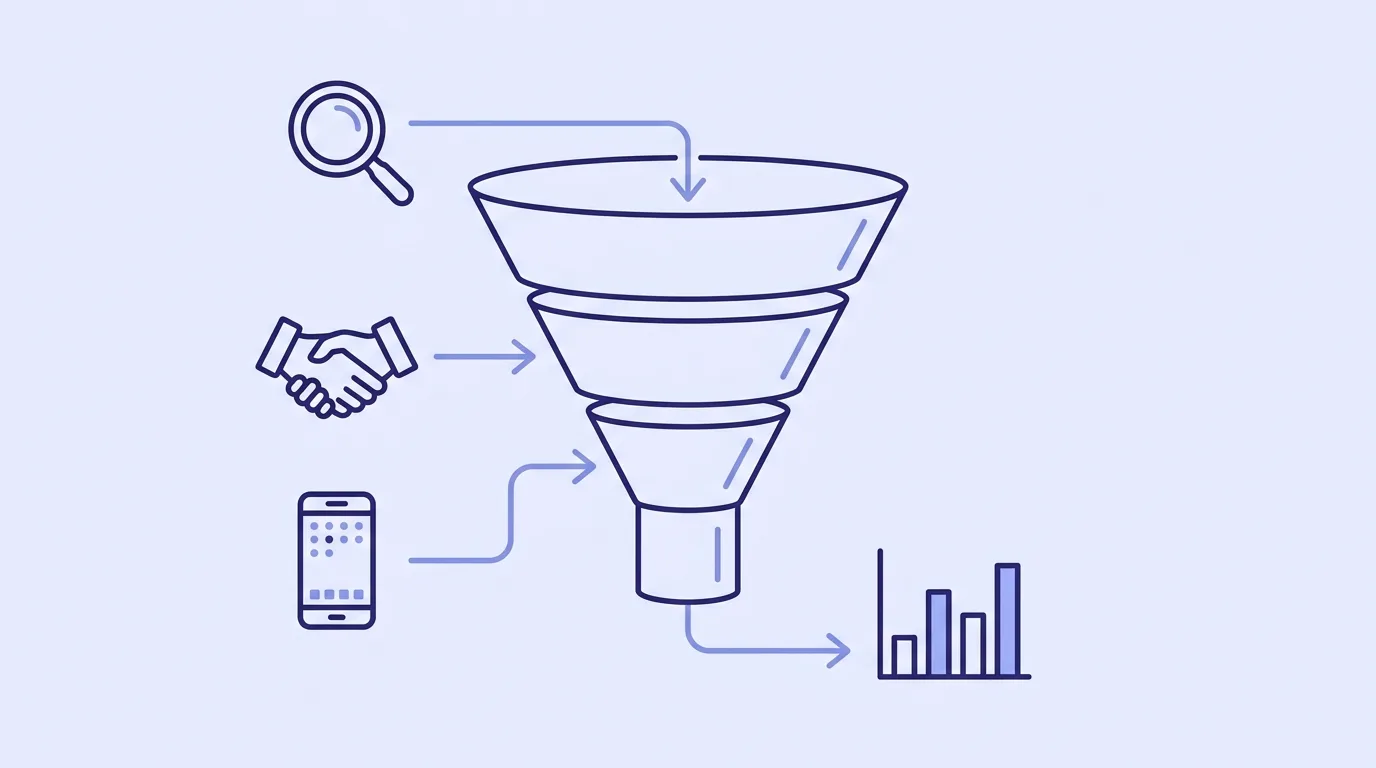
A real estate lead generation funnel has four distinct stages, each with its own conversion problem.
Attention. Someone realises they need to buy or sell. They search Google, scroll through Trade Me Property, see a Facebook ad, or get a referral. This is where your marketing first touches them.
Capture. They do something that puts them in your pipeline: fill in a form, call a number, book an appraisal, or follow your page. Most marketing activity in real estate is aimed at triggering this one step.
Nurture. This is where most agents underperform. The buyer who enquires in July might not be ready to transact until March. If you do not have a systematic follow-up process in place, that lead finds another agent through natural attrition. Most real estate buyer cycles run to months, not days.
Convert. They choose you, as the listing agent, buyer’s agent, or property management provider. This is the only step that generates revenue, which means every upstream conversion rate is directly linked to your bottom line.
The maths matter. If you capture 100 enquiries, nurture 60 of them properly, and 8 of those transact with you over the following 12 months, your funnel conversion rate is 8%. That figure determines your maximum allowable cost per lead, and it is a number most agents have never calculated.
What a Real Estate Lead Is Actually Worth
This is the calculation most agents skip. It is also why they either overpay for poor leads or underspend to the point of starving their pipeline.
Work backwards from a transaction. On a residential property at the national median sale price, the gross commission to the agency (at a typical blended rate) can run to $15,000 to $22,000, depending on the property value and the agency’s fee structure. After the agent’s split and franchise fees, a realistic net per transaction for an independent agent might sit between $8,000 and $14,000.
Now run the funnel backwards. If you close 1 in 10 captured leads, a conversion rate achievable with consistent follow-up, and each closed deal nets you $10,000, then each captured lead is worth $1,000 in expected value.
At that number, paying $200 per lead is not expensive. It is a 5:1 return before you account for referrals and repeat business.
The arithmetic to run for your own situation:
Average net commission per transaction x your lead-to-close rate = value per enquiry
If that number is $800, spending $150 per lead is rational. If it is $1,500, you have significant room to build a real paid pipeline. The only wrong answer is not calculating it at all and defaulting to gut feel.
The Five Main Lead Generation Channels, Compared
Choosing where to spend comes down to understanding what each channel actually delivers, not what the platform promises.
Google Ads
Search captures people who are actively looking. “Real estate agent Wellington”, “property appraisal Auckland”, “sell my house fast Christchurch.” The intent is explicit. Someone typing those searches has already decided they want to talk to an agent.
The downside is competition. Popular terms in major NZ cities attract established agencies with serious budgets, and cost per click climbs accordingly. You need a high-converting landing page and disciplined negative keyword management to make the economics work. Our Google Ads vs Facebook Ads comparison for NZ service businesses covers the channel trade-offs in more depth.
Where Google Ads earns its place in real estate is specifically on vendor intent searches: the terms people use when they are getting close to listing. These leads convert faster, and a listing commission is typically worth more than a buyer-side deal. If you only have budget for one paid channel, start here.
Meta Ads (Facebook and Instagram)
Meta’s strength in real estate is audience-based targeting. You are not waiting for someone to search. You are appearing in the feed of someone who matches a profile you define: homeowners in a target suburb with demographic characteristics aligned with your typical lister, for example.
This creates a different kind of lead. A Google lead knew what they wanted before they clicked. A Meta lead was not necessarily thinking about it, which means they are earlier in the process and need more nurturing before they transact.
Meta works well for building market awareness in a suburb, running vendor appraisal campaigns (“find out what your home is worth today”), and retargeting people who visited your website but did not enquire. It is less reliable for generating immediate transaction intent. Budget accordingly and do not judge a Meta campaign at six weeks. The leads need time to mature.
Property Portals
Trade Me Property and realestate.co.nz aggregate buyer and renter traffic at scale. Many agencies pay for premium placement or advertiser profiles to capture enquiries from people already browsing listings.
The advantage is that the leads are clearly property-motivated. The limitation is that portal leads are comparison shoppers. They are not specifically looking for your agency. Differentiation is harder when every agency is listed in the same directory.
Portal leads tend to work better for buyer enquiries than vendor capture. For appraisal and listing leads, direct advertising on Google or Meta typically produces better returns than portal spend alone.
Organic Search (SEO)
Real estate is one of the sectors where strong local SEO can generate consistent inbound enquiries without ongoing ad spend. An agent who ranks well for “Ponsonby real estate agent” or “property management Tauranga” will receive regular organic contact.
The honest caveat is that local SEO for real estate is competitive and slow. The major agencies have domain authority that took years to build. Getting into the top positions in competitive suburbs requires a sustained content and technical effort, usually six to twelve months before meaningful traffic arrives.
SEO shines in niche markets and smaller towns where competition is lower, and as a long-term complement to paid channels rather than a standalone strategy. The economics are compelling if you can be patient, but it is not a substitute for building a paid pipeline today.
Referrals and Direct Prospecting
Cold outreach to homeowners in a target suburb, through letterbox drops, personal calls, or relationship building, remains the foundation strategy for many top-performing agents alongside digital. It is not as scalable as paid advertising, but it is relationship-driven and produces a different quality of conversation.
Referrals are the most valuable lead source in real estate and the cheapest to acquire, once you are performing at a level where clients actively recommend you. Building a formal referral process is worth the effort but takes time to produce volume. It is not a substitute for a systematic inbound strategy in the early stages.
The Speed-to-Lead Problem
Every lead generation channel shares one critical vulnerability: leads go cold quickly. Research on lead response speed consistently shows that the odds of converting a lead drop dramatically after the first few minutes without contact.
In real estate this problem is acute. A vendor who fills in an appraisal request at 8pm on a Saturday is in a state of intent right now. By Monday morning they have browsed more agents, received a call from someone faster, and the urgency has passed.
The practical fix is a response system, not a heroic hustle ethic. An automated acknowledgement within two minutes, followed by a personal call or message within 30 minutes, is achievable without being permanently attached to your phone. Setting up SMS or email automation for after-hours enquiries buys goodwill and keeps the lead warm until you can follow up personally.
If you are running any paid lead generation and not responding within 30 minutes, you are wasting a significant portion of what you spend.
Lead Quality vs. Lead Volume
The single biggest mistake in real estate lead generation is optimising for volume. More enquiries do not mean more transactions if the leads are unqualified.
A qualified real estate lead has three characteristics. They have a genuine need: buying, selling, or renting within a defined timeframe. They have the financial capacity to transact. And they are willing to engage with you specifically, not just with the market in general.
The qualification problem in real estate is particularly sharp because people actively researching but not yet ready to transact will fill in forms, take calls, and consume your time without ever closing. This is not dishonesty. It is the natural shape of the buyer and seller journey, which involves extended research before commitment.
Two things reduce wasted effort here. First, the intake form: a well-designed appraisal request or buyer enquiry form that asks about timeframe and motivation will self-select better leads without feeling intrusive. Second, a CRM-based nurture system that keeps medium-term leads engaged without requiring your daily attention. Getting your CRM set up properly for lead conversion is the infrastructure investment that makes lead generation profitable over time rather than an expensive exercise in chasing people who are not ready.
The Conversion Problem Nobody Talks About
Most lead generation advice focuses entirely on the top of the funnel, the advertising and the capture. The conversion problem is at least as significant.
In real estate, losing the listing at the appraisal stage after paying to generate the vendor lead is the most common form of wasted marketing spend. You paid to get in the door. The competitor who presented more convincingly got the listing.
If your close rate at appraisal is lower than you want, that is a conversion problem, not a lead generation problem. Spending more on advertising will not fix it. Improving your listing presentation, your market data, your fee structure, or your follow-up speed after the appraisal will.
Track these separately. Measure your lead-to-appraisal rate (how many leads become booked appraisals?) and your appraisal-to-listing rate (how many appraisals result in a signed agreement?). If the first number is weak, the problem is speed or follow-up. If the second is weak, the problem is the presentation itself.
Does Lead Generation Make Money in Real Estate?
It does, but only when the fundamentals are right. The funnel has to work from capture to close, not just the advertising at the top.
Agents who find lead generation unprofitable almost always have one of three underlying issues. Their follow-up is inconsistent, so leads they paid for go cold before they are ready to transact. Their appraisal conversion rate is low, so they generate vendor interest but lose the listing to someone else. Or they are measuring cost per lead instead of cost per closed transaction.
If you track cost per closed transaction rather than cost per enquiry, the maths usually becomes encouraging. Spending $4,000 a month on paid advertising and closing two listings from it at $12,000 net each returns $20,000 on a $4,000 investment. The only way to know your own version of those numbers is to track every lead from channel to close. This is why conversion tracking set up properly from day one is not optional. It is the foundation on which every marketing dollar sits.
What Lead Generation Services Actually Cost
Two models dominate the market.
Managed advertising. You pay an agency a monthly management fee to run your Google or Meta campaigns. In the New Zealand market, fees for a single agent or small team typically start from around $800 to $2,000 per month, plus your own ad spend on top. The benefit is expertise and time savings. The risk is agencies that optimise for enquiry volume rather than enquiry quality.
Pay-per-lead services. A provider charges a fixed fee per enquiry delivered. Prices vary by lead quality, geography, and exclusivity. Exclusive leads (sent only to you) cost more per lead but convert at substantially higher rates than shared leads, which are sold to multiple agents simultaneously.
The question to ask any lead generation service is not “how much per lead?” but “are these leads exclusive, what is the source, and can you show me outcomes for your real estate clients?” A $300 exclusive vendor enquiry from a motivated homeowner is worth far more than a $60 shared lead that three other agencies are also calling within the same hour.
Ready to Build a Real Pipeline?
Real estate lead generation works when the economics are clear, the right channel is chosen for your market, and the follow-up system is built before you turn on the tap. Most agents get these out of order and then conclude that paid lead generation does not work.
If you want a clear view of what a lead generation strategy could return in your market and price bracket, book a strategy call with the Lucid Leads team. We will give you straight numbers on what to expect before you commit to anything.
Frequently Asked Questions
How does lead generation work in real estate?
Lead generation in real estate is the process of attracting buyers or vendors into your pipeline before they have chosen an agent. Advertising on Google or Meta generates enquiries, those enquiries are captured in a CRM, and then nurtured over weeks or months until the prospect is ready to transact. The key distinction from most industries is that the buyer or vendor cycle is long, so the follow-up system matters as much as the advertising.
How much should I pay for lead generation in real estate?
Calculate your average net commission per transaction and multiply by your enquiry-to-close rate. If you net $10,000 per deal and close 1 in 10 leads, each lead is worth $1,000 in expected value. Paying $150 to $400 per exclusive lead at that ratio is rational. The right number depends on your market, your commission structure, and how well your conversion process performs.
What is the best lead generation company for real estate?
There is no universal answer because performance depends on your market, your follow-up speed, and the channel fit for your target client. The criteria that matter most are lead exclusivity (are you the only agent receiving this enquiry?), source transparency (where exactly is the lead coming from?), and whether the provider tracks performance to transaction rather than just enquiry volume.
Does lead generation make money in real estate?
Yes, when conversion is working. The agents who find it unprofitable are typically not tracking leads from source to close, or they are losing the listing at appraisal after paying to generate it. Fix the conversion process before scaling advertising spend.
How long does it take to see results from real estate lead generation?
Paid search and social ads can generate enquiries within days of going live. The time to a closed transaction depends on the buyer or vendor’s timeline, which typically runs to several months. Most agents running a well-managed paid campaign see their first completed transaction within 60 to 120 days of starting. The pipeline then compounds as nurtured leads mature and referrals emerge from early clients.
Ready to Generate More Leads?
Let's discuss how we can help you get 30 qualified leads in 30 days with our proven TAP System.
Book a Free Strategy CallRelated Articles
Continue learning about lead generation and paid advertising

Lead Gen News: July 2026 - Google's Journey Bidding, New Lead Dashboard, and Meta's AI Creative Push
The latest in lead generation: Google's journey-aware bidding, new lead dashboard, Local Services Ads changes, DSA retirement, and Meta's AI creative push.
Lead Generation as a Service: How It Works, What It Costs, and When to Buy It
Lead generation as a service explained: what you actually get, how much to pay, and whether an outsourced model beats DIY for NZ service businesses.
Written by

Founder & Lead Generation Specialist
Jason Poonia is the founder of Lucid Leads, helping service businesses across New Zealand generate qualified leads through paid advertising and conversion-focused funnels. With a background in Computer Science from the University of Auckland and over 5 years of experience running lead generation campaigns, Jason has helped businesses in construction, trades, real estate, and professional services generate thousands of qualified leads. His data-driven approach combines targeted ad strategies with rapid lead qualification to deliver prospects who are ready to buy.