
Clicks Are a Vanity Metric: Track Profit, Not CTR, on Google Ads
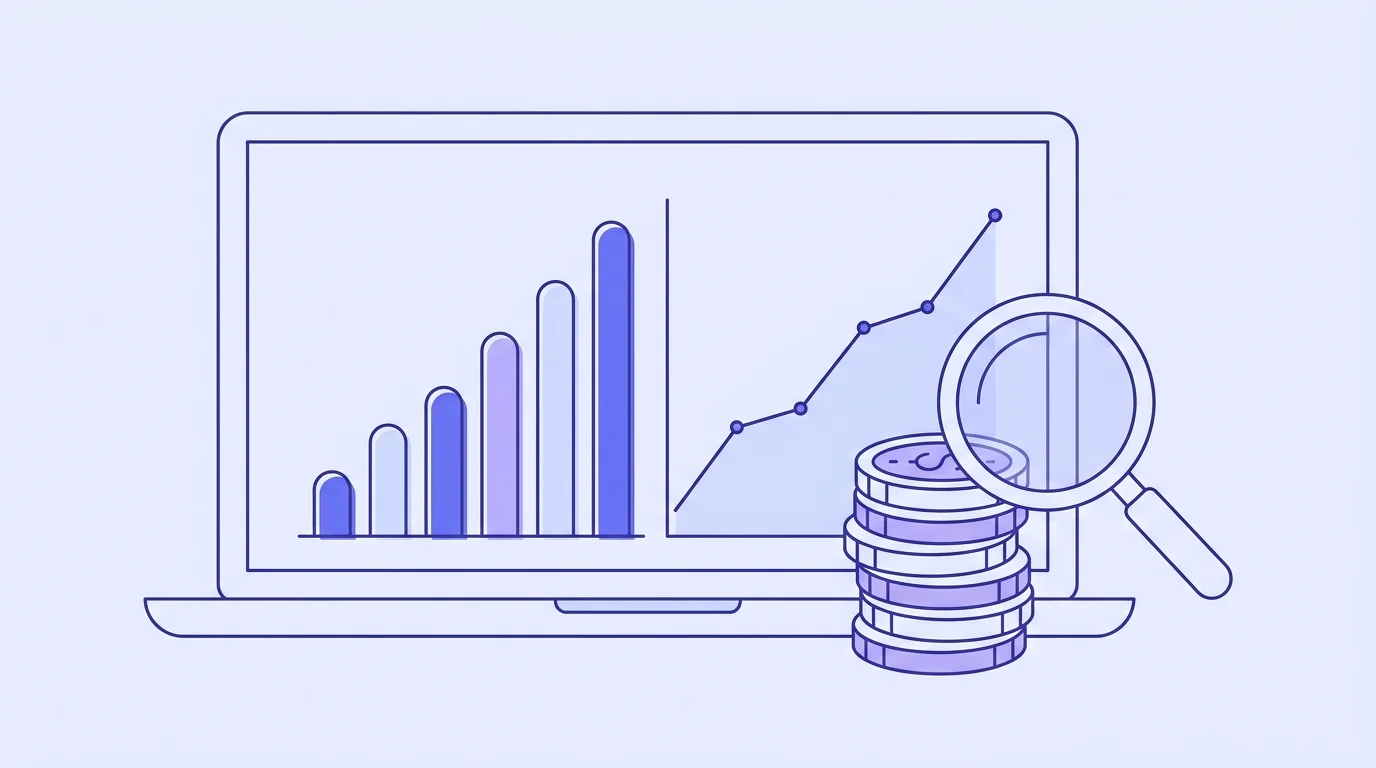
Your Google Ads dashboard can look fantastic while your bank account stays flat. Impressions up, clicks up, click-through rate up, and yet the number of booked jobs barely moves. That gap is the most expensive misunderstanding in paid advertising, and almost every service business we audit falls into it.
The metrics Google puts in front of you are not the metrics that pay your wages. If you want Google Ads to make you money rather than just spend it, you have to measure the right thing and ignore the noise. Here is how to tell the difference.
The numbers Google wants you to watch
Google is a brilliant advertising platform, but it is not a neutral party. Its revenue goes up when your spend goes up, so a lot of what the platform nudges you toward is designed to grow your budget, not your profit.
Three things to treat with healthy suspicion:
- The optimisation score and recommendations. That little percentage and the list of “apply these to improve your account” suggestions almost always push you toward broader targeting, higher budgets, and automated features that benefit the platform first. Some recommendations are fine. Most are not for your benefit.
- The weekly call from your account rep. Reps are usually measured on how much their accounts spend, not on how profitable those accounts are. A friendly nudge to “increase your daily budget” is not the same as advice to make you money.
- The impressive-looking analytics. Impressions, clicks, and click-through rate feel like progress. They are not. Neither, on its own, is a form submission.
The only metric that actually matters
Here is the uncomfortable truth: a lead is not a sale. A form fill can be spam, a tyre-kicker, a competitor, or someone who will never be a fit. If you optimise toward leads, you will get more leads, and a good chunk of them will be worth nothing.
What matters is profit. For a service business that usually comes down to two numbers:
- Cost per booked job (or cost per sale), not cost per click or cost per lead.
- Return on ad spend (ROAS), the revenue you earn for every dollar you put into Google.
If you are spending $2,000 a month and that produces $14,000 of booked work, you have a 7x return and a campaign worth scaling. If it produces $1,800 of work, no amount of strong click-through rate makes that a win.
The attribution problem nobody solves
Picture a business turning over $58,000 a month from several channels at once: Google Ads, SEO, social media, referrals, and a third-party lead site or two. The owner looks at Google Ads, sees plenty of enquiries, and assumes it is working.
But which of those paying customers actually came from Google? Without tracking the path from search to sale, you genuinely cannot say. So you keep funding channels out of habit, and you cut the wrong ones when money gets tight. The whole point of measurement is to let you double down on what produces paying customers and stop paying for what does not.
How to track Google Ads down to the dollar
This is a five-step pipeline. None of it is glamorous, and all of it is worth it.
1. Tag your ads with URL parameters
Every ad click should carry context in the URL: the keyword, the campaign, the Google click ID (gclid), and the source and medium (google / cpc). That data rides along to your landing page.
2. Capture it with hidden form fields
Your landing page form can hold hidden fields the visitor never sees. They quietly read those URL values so that every enquiry arrives stamped with where it came from and which keyword and campaign produced it.
3. Log it in your CRM
When the form is submitted, that lead lands in your CRM with a name, contact details, source, keyword, campaign, and click ID attached. Now a lead is not anonymous, it has a paper trail.
4. Record the revenue when they pay
When that customer pays an invoice, record the actual dollar value against their record. Do this across all your customers and you can finally see true return on ad spend, not an estimate, down to the cent.
5. Feed the data back to Google
Here is the step almost everyone misses. Your dashboard knows what each customer paid, but Google does not. Export your real conversion values and upload them back into Google Ads as offline conversions. Now the platform optimises toward the people who actually pay you, and it goes looking for more people like them. This is where good accounts pull away from average ones.
Start with conversions, then graduate to ROAS
You cannot bid on profit from day one because the account has no data yet. Begin by optimising for conversions (qualified enquiries), gather a few weeks of clean data, then move to value-based or ROAS bidding once Google has enough signal to chase revenue rather than raw lead volume. Getting the order right matters as much as the destination.
The cheapest conversion boost has nothing to do with Google
Once an enquiry comes in, the single highest-leverage thing you can do costs nothing in ad spend: call them within 60 seconds. The average business takes around 48 hours to respond. Speed alone can lift sales dramatically, because the lead is still hot and you are the first voice they hear. You can win more work without spending another dollar on ads, simply by picking up the phone faster.
This is exactly why we pair every campaign with fast follow-up and proper lead qualification. Generating the enquiry is only half the job, converting it is the other half.
Measure what pays, ignore what flatters
Clicks, click-through rate, and even raw lead counts are vanity metrics. They feel good and tell you very little. Track the path from search to paid invoice, feed real revenue back to Google, and respond to enquiries fast, and you will finally know whether Google Ads is making you money, which is the only question worth answering.
If you want a second set of eyes on what your account is really producing, book a free strategy call and we will map your numbers from click to customer.
Frequently asked questions
What is a good ROAS for a service business?
It depends on your margins and customer lifetime value, but most service businesses want to see at least 3x to 5x return on ad spend before tax, and often much more once repeat work is included. The right target is the one that leaves healthy profit after you account for the job’s true cost. Our cost per lead benchmarks are a useful starting point.
Are clicks and click-through rate ever useful?
Yes, as diagnostic signals rather than goals. A low click-through rate can warn you that an ad does not match the search intent, and click data helps Google’s bidding learn. Just never mistake them for results. Revenue is the result.
How long before I can switch to ROAS bidding?
You generally need a meaningful volume of tracked conversions first, often a few weeks to a couple of months depending on your budget and search volume. Switch too early and the algorithm has nothing to learn from. Our NZ Google Ads cost guide covers how budget affects this.
Why are my Google Ads leads low quality?
Usually because the account is optimised for cheap clicks or broad keywords rather than buyer intent, or because no revenue data has been fed back to Google. Tightening keywords, capturing source data, and uploading real conversion values typically lifts lead quality fast. See our guide to generating high-quality leads with Google Ads.
Ready to Generate More Leads?
Let's discuss how we can help you get 30 qualified leads in 30 days with our proven TAP System.
Book a Free Strategy CallRelated Articles
Continue learning about lead generation and paid advertising

The Keyword Mistake That Burns NZ Service Businesses' Ad Budget
Wasted Google Ads spend usually comes from the wrong keywords and match types. Here is how NZ service businesses pick keywords that turn into paying customers.

Landing Pages That Turn Google Ads Clicks Into Booked Jobs
Perfect keywords mean nothing if the page does not convert. Here are the landing page elements that turn NZ Google Ads clicks into booked jobs and real enquiries.
Written by

Founder & Lead Generation Specialist
Jason Poonia is the founder of Lucid Leads, helping service businesses across New Zealand generate qualified leads through paid advertising and conversion-focused funnels. With a background in Computer Science from the University of Auckland and over 5 years of experience running lead generation campaigns, Jason has helped businesses in construction, trades, real estate, and professional services generate thousands of qualified leads. His data-driven approach combines targeted ad strategies with rapid lead qualification to deliver prospects who are ready to buy.