
Lead Gen News: October 2026 - PMax Gets A/B Testing, Google's Auto-Promotion Risk, and Meta's AI Lead Agent
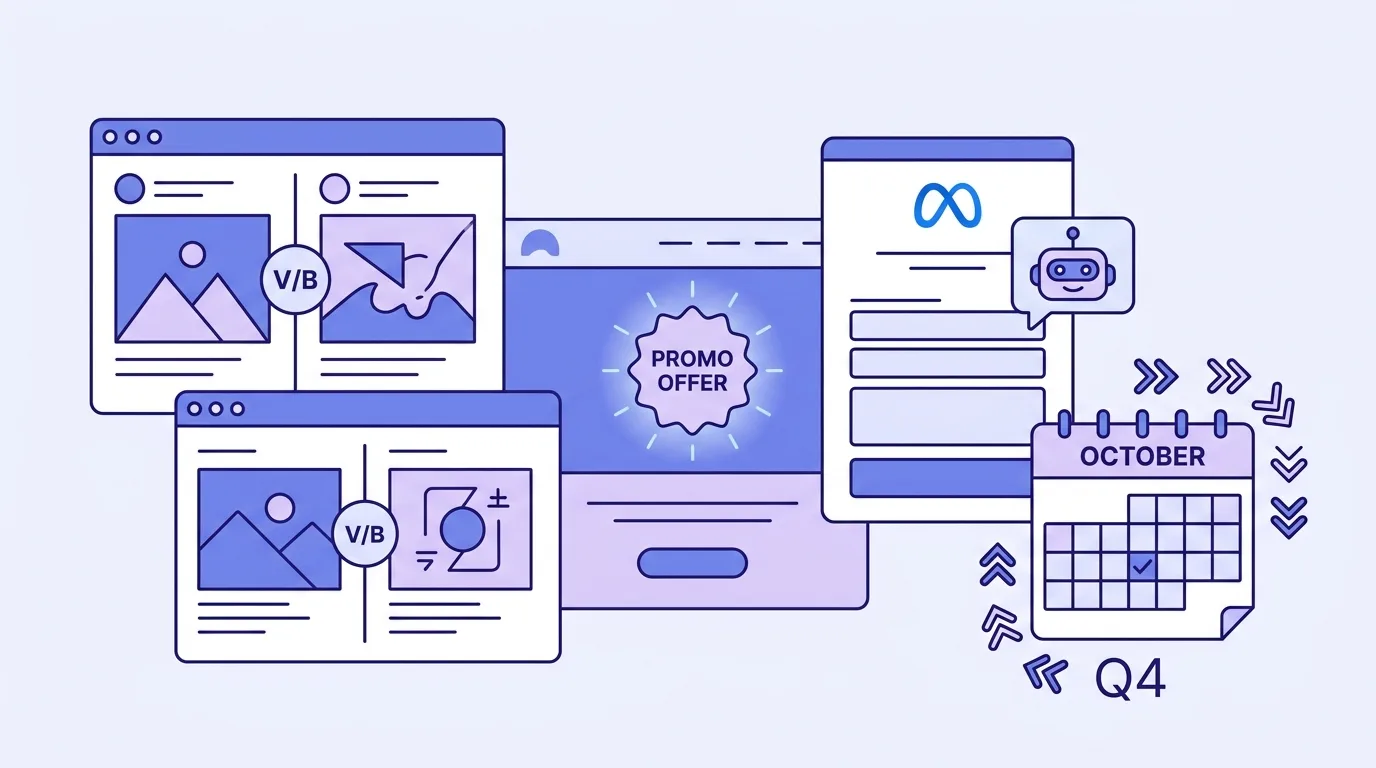
Four changes across Google and Meta in the past week directly affect NZ service businesses running paid lead generation heading into Q4. Performance Max now has native creative A/B testing for the first time. Google launched an automated feature that reads your landing pages and attaches promotional copy to your ads without asking. Meta’s AI lead agent is rolling out inside instant forms. And Google’s Promotion Mode gained proper Q4 scheduling controls.
Here is what changed, why it matters, and what to do this week.
Google Automated Promotions: Check Your Landing Pages Now
First spotted on September 7 and reported on September 8, Google quietly launched an account-level automated asset called Automated Promotions. It scans the landing pages tied to your Search and Performance Max campaigns, extracts any promotional language it finds, formats it into a Promotion asset, and attaches it to your ads.
There was no blog post from Google announcing this. No notification in the account. The feature activates automatically if your account meets three conditions: you have an active Search or Performance Max campaign, Location Assets are attached, and you have not already uploaded manual promotion assets.
For a service business with no promotional language on its landing pages, this does nothing. For anyone who has run a limited-time offer, has a seasonal pricing banner buried in a page template, or left old promotional copy on a landing page after a campaign ended, this is a live problem.
Where it breaks
The risk is on your website, not inside your ad account.
Three specific failure modes. First, expired offer banners that were never removed from pages. Google re-verifies detected promotions within 24 hours, meaning an offer block from three months ago that was never taken down can appear as a current offer in your ads today.
Second, branch-specific or regionally scoped offers on pages that serve nationally. Performance Max does not respect the intended geography of an offer. If a Wellington office ran a discount last quarter and the promotional text is still on a service page receiving national traffic, that offer is a candidate for attachment to a PMax campaign serving the entire country.
Third, conditional offers where the qualifying terms sit on a separate page. Google extracts the headline offer and not the footnote. A “30% off your first appointment” banner with an asterisk pointing to exclusions on a terms page surfaces as an uncaveated 30% discount in your ads.
What to do
Check your account-level automated asset settings now, specifically the Automated Promotions row. If the feature is active and you do not want it, opt out, or upload a manual Promotion asset for the affected campaigns. Manual assets disqualify the account from automated application.
Then audit every page used as a final URL across your Search and PMax campaigns. Look for: any offer block, anything framing a percentage or dollar figure as a discount, and any promotional copy left over from previous campaigns. If it would read as an offer to a Google crawler, treat it as currently live.
One practical rule worth establishing: no promotional block should go on a landing page without a hardcoded end date, so the page self-corrects after the offer expires rather than relying on someone remembering to remove it.
Performance Max Finally Gets Native A/B Testing
Launched on October 2, Google has added native creative experimentation to Performance Max campaigns. Advertisers can now designate control assets and treatment assets within the same asset group, assign common assets that serve across both variations, and set the traffic split between them.
Before this, testing creative in PMax required duplicating the entire campaign. That approach introduced audience overlap, diluted the training data each campaign received, and made any result ambiguous because you were comparing two separate learning algorithms operating on different data. A native experiment removes that contamination: both variations serve within the same campaign, against the same audience signals, with a clean traffic split.
Google recommends a minimum four-to-six-week run time before reading results. When an experiment starts, all assets in the tested group move to view-only mode. You cannot add or edit creative mid-test. Plan the full set of assets before launch.
What this changes for lead gen accounts
The most useful application is testing the core claim in your creative, not just the format. A video built around a specific outcome versus a video built around a price anchor. A headline focused on speed versus a headline focused on expertise. A testimonial image versus a process walkthrough.
Previously, that kind of directional test was practically impossible in PMax without the campaign contamination described above. Now it is a structured experiment you can run and read cleanly.
According to the common thread Google Ads changes tracker, campaigns with video assets included in tested asset groups are showing 25 to 40% performance improvements in early testing. That range reflects how much creative variation matters in PMax performance and why the absence of native testing had been a significant gap for the format.
For a breakdown of when Performance Max makes sense for lead generation versus standard Search, the comparison between Search and PMax covers the structural trade-offs.
Meta’s AI Lead Agent: Conversational Forms Are Rolling Out
Meta is rolling out a Lead Capture AI Agent inside the instant form format. It appears as an opt-in toggle at the ad level, labelled “Enable lead capture AI agent” inside form settings. It is not a replacement for the standard form. Meta’s system decides per user, at the moment an ad is clicked, whether to show a standard instant form or engage the AI agent in a back-and-forth conversation.
The practical difference: the agent can answer basic questions about your business during the exchange, using information drawn from your existing form and website. If a prospect clicks a lead ad and wants to ask whether the service is available in their area, or what the initial process looks like, the agent can respond before collecting contact details. The standard form cannot do that. It is a static sequence; the agent is a dialogue.
Meta’s rationale is that a higher-friction initial exchange filters out weaker leads before submission, so the leads that complete the form have already self-qualified to some degree. That logic holds for high-value services where a bad lead costs real time to process and dismiss.
Current limitations
The feature is English-only at launch. It does not support conditional logic, conversion-lead optimisation, or appointment booking requests inside the form. Regulated verticals, including financial services, health, and employment, housing, and credit categories, are excluded entirely.
The rollout is still in progress and the feature is not available in all accounts. If the toggle is not visible in your instant form settings, your account has not yet entered the rollout.
For NZ service businesses, this means financial advisers, mortgage brokers, and healthcare providers cannot use the Lead Capture AI Agent in its current form. Trade businesses, professional services without a financial or health classification, marketing and consulting firms, and education providers are better-placed candidates.
How to approach the test
If the toggle is available in your account, the most useful first test is a split: one campaign with the AI agent enabled against a matched campaign on the standard form, with creative and budget held constant. The metric that matters is cost per qualified lead, not total form submissions. A conversational agent may produce fewer submissions but a higher proportion worth following up. If your current cost per lead is inflated by unqualified submissions that drain your team’s time, that trade-off is worth exploring.
For context on how Meta’s broader automation stack fits together, the Advantage+ guide for NZ service businesses covers how the AI layers interact with audience and budget decisions.
Two Google Tools to Activate Before Q4 Spend Increases
Promotion Mode Gets Proper Q4 Scheduling
On September 30, Google added proper scheduling controls to Promotion Mode in Search and PMax campaigns. Advertisers can now set a start date and end date for a promotional period, configure a ROAS tolerance for how aggressively the algorithm should pursue promotional traffic, and allocate extra daily budget specifically to the promotional window.
The key constraint: once Promotion Mode is live, the baseline Target ROAS locks for the duration of the promotional period. It cannot be adjusted while the mode is running. Set the baseline at a level you are comfortable holding before you activate it. If your strongest lead generation window is November or the lead-up to Christmas, configure and test the Promotion Mode settings in October, before you actually need them.
Google reports an 18% increase in unique converting query categories when Promotion Mode is combined with Smart Bidding Exploration. For service businesses trying to reach buyers who are not already searching for exact branded or category terms, that kind of reach expansion during a known high-intent seasonal window has a clear practical use.
AI Max Search Journey Report
Alongside the Customer Match IP update covered in last month’s roundup, Google also launched a unified Search Journey Report for AI Max campaigns. The report shows the complete path from search query to which creative asset served to which landing page the traffic reached, in a single view.
For accounts running AI Max, this is the most direct diagnostic for understanding where the algorithm is overreaching. A query category generating impressions but no conversions marks where the expanded matching is targeting the wrong audience. A landing page receiving AI Max traffic that was never designed to capture that query type is a gap this report now makes visible.
Pull this report before Q4 spend increases. Issues that are manageable at lower volume will amplify as November budgets lift. Fixing them in October costs a fraction of what fixing them in December does.
The Common Thread Heading Into Q4
Three of the four updates this week involve Google or Meta making changes to your account without being asked. Automated Promotions activates by default if your account is eligible. PMax A/B testing locks your assets once an experiment starts. The AI lead agent changes the experience a prospect has after clicking your ad.
The one update fully in your hands is Promotion Mode scheduling, and that is also the one most likely to be ignored until it is too late to configure it properly.
The pattern is consistent with everything that has changed across both platforms in 2026. Automation is expanding. The businesses that benefit are those putting deliberate inputs into the system: clean landing pages, structured creative tests, and conversion goals that reflect real sales outcomes rather than just form submissions. The businesses that get dragged along are those reacting to changes after the algorithm has already been running for weeks on default settings.
October is early enough to get ahead of this. November will not be.
If you want a clear-eyed assessment of how your campaigns are positioned heading into Q4, book a free strategy call with Lucid Leads.
Frequently Asked Questions
Is the Automated Promotions feature active in my account right now?
Possibly. It activates if your account has an active Search or Performance Max campaign, Location Assets attached, and no manual promotion assets already uploaded. Check your account-level automated asset settings to see whether Automated Promotions is listed and enabled.
Does the PMax A/B testing work for lead generation campaigns or only ecommerce?
It applies to all Performance Max campaign types, not only product-feed campaigns. Lead gen PMax accounts can run native asset experiments from October 2. You will need sufficient conversion volume, roughly 30 or more per month, for the experiment to reach a readable result within the recommended four-to-six-week run time.
Can I use Meta’s Lead Capture AI Agent for a mortgage brokerage or healthcare practice?
No. The Lead Capture AI Agent is restricted from regulated verticals including financial services, health, and employment, housing, and credit categories. If your campaigns run under any of those categories, the toggle will not be available in your form settings regardless of rollout status.
Does Promotion Mode work for service businesses or just ecommerce?
It works for both. For service businesses, the most common use case is a promotional offer tied to a specific window, such as a reduced-fee introductory consultation or a time-limited service package. The baseline Target ROAS locks once the mode activates, so set it deliberately before launch rather than adjusting it reactively.
Where do I find the AI Max Search Journey Report?
It is inside the AI Max campaign reports in Google Ads, under the campaign’s reporting tab. It is a campaign-level view, not a standard ad group or keyword report, and it only appears for campaigns with AI Max features enabled. Look for a “Search term journey” label or similar in the campaign reporting options.
Related Articles
Continue learning about lead generation and paid advertising

Lead Gen News: Late October 2026 - Google's LSA Merger, Meta's Product Browsing Deadline, and New Channel Priority Controls
Google folds Local Services Ads into Performance Max. Meta enables product browsing in existing ads on 28 October. New channel controls cap Display budget spend.

Lead Gen News: Mid-October 2026 - Google Automated Promotions Live, Meta's AI Campaign Manager, and Free Incrementality Testing
Google automated promotions went live 12 October. Meta launched an AI campaign manager at Ad Week. Self-serve conversion lift now open for Search and PMax.
Written by

Founder & Lead Generation Specialist
Jason Poonia is the founder of Lucid Leads, helping service businesses across New Zealand generate qualified leads through paid advertising and conversion-focused funnels. With a background in Computer Science from the University of Auckland and over 5 years of experience running lead generation campaigns, Jason has helped businesses in construction, trades, real estate, and professional services generate thousands of qualified leads. His data-driven approach combines targeted ad strategies with rapid lead qualification to deliver prospects who are ready to buy.